Micah Bayless Asked a Pikes Peak Champion One Question. The Answer Became the Wildest Electric 911 Ever Built.
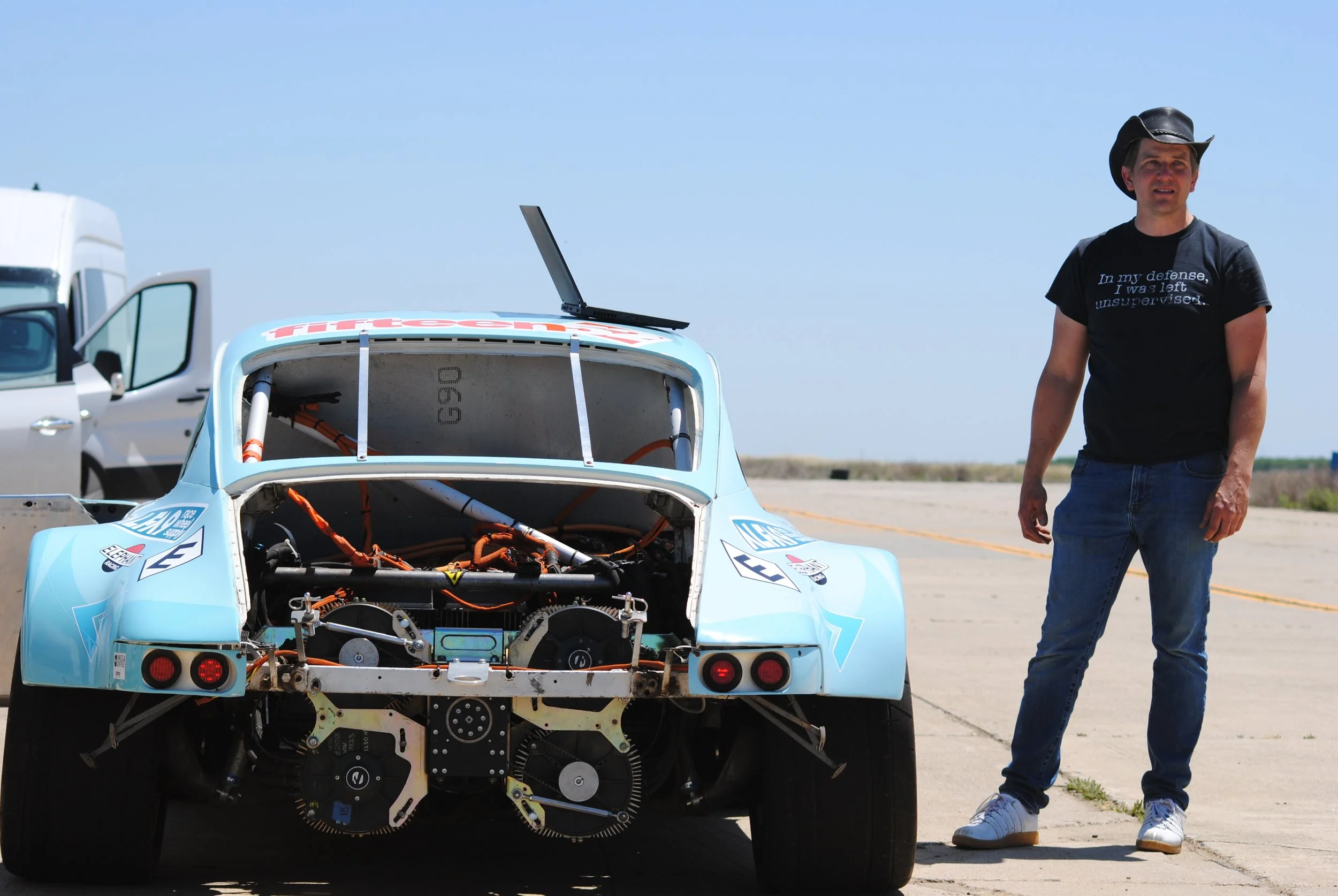
Micah Bayless with the 911 RSR “Casper”
Micah Bayless converted a 1973 Porsche 911 RSR, a former Pikes Peak class winner, to eight Zero Motorcycles motors and roughly 500 horsepower. In this post we take a look inside the build, the air cooled strategy, and the plan to break ten minutes in 2027.
Why would anyone put eight motors in a Porsche?
The car sits on stands with its transmission out and its interior stripped to bare metal. You can see straight through it. That almost never happens with a race car that has already won something, and this one has. As a gasoline car, this Porsche 911 won its class at the Pikes Peak International Hill Climb, 156 turns and 12 miles of mountain ending above 14,000 feet.
Now it has eight electric motors in it.
I asked Micah Bayless the obvious question first. If one motor is enough, is eight motors better? He did not hedge. Eight motors is not a stunt on this car. It is the answer to a problem that started with four motors, got solved with six, and then got outgrown again.
Who is Micah Bayless, and how did a blown engine start all this?
Around 2015, Micah had an old Porsche 912 that had been his family's car, bought from his father. The engine blew up. He looked at the repair bill and did the math on a rebuild, and he decided not go the way Porsche rebuilds usually go.
He was working at Zero Motorcycles at the time. He had spent years around the company's electric powertrains and he was proud of them. He looked at the worn Porsche engine case and could 'see' four Zero motors propelling a prop-shaft with flywheel in a flat-4 configuration, just like the 912 engine configuration with roots in the 356. Batteries measured to fit where the fuel tank used to be.
That is the part people miss about this whole project: the first version was not a race program, it was a guy deciding that his family car deserved something more than being held as a snapshot in time, it deserved to be rebuilt for the future.
A few CAD files and a set of measurements later, he had a running four motor, two battery 912. He grew up doing hill climbs, and the four motor car was already more than he could handle. So he decided he should get back into competition properly.
He went looking for Porsches that had run hill climbs. He found Chris Lennon.
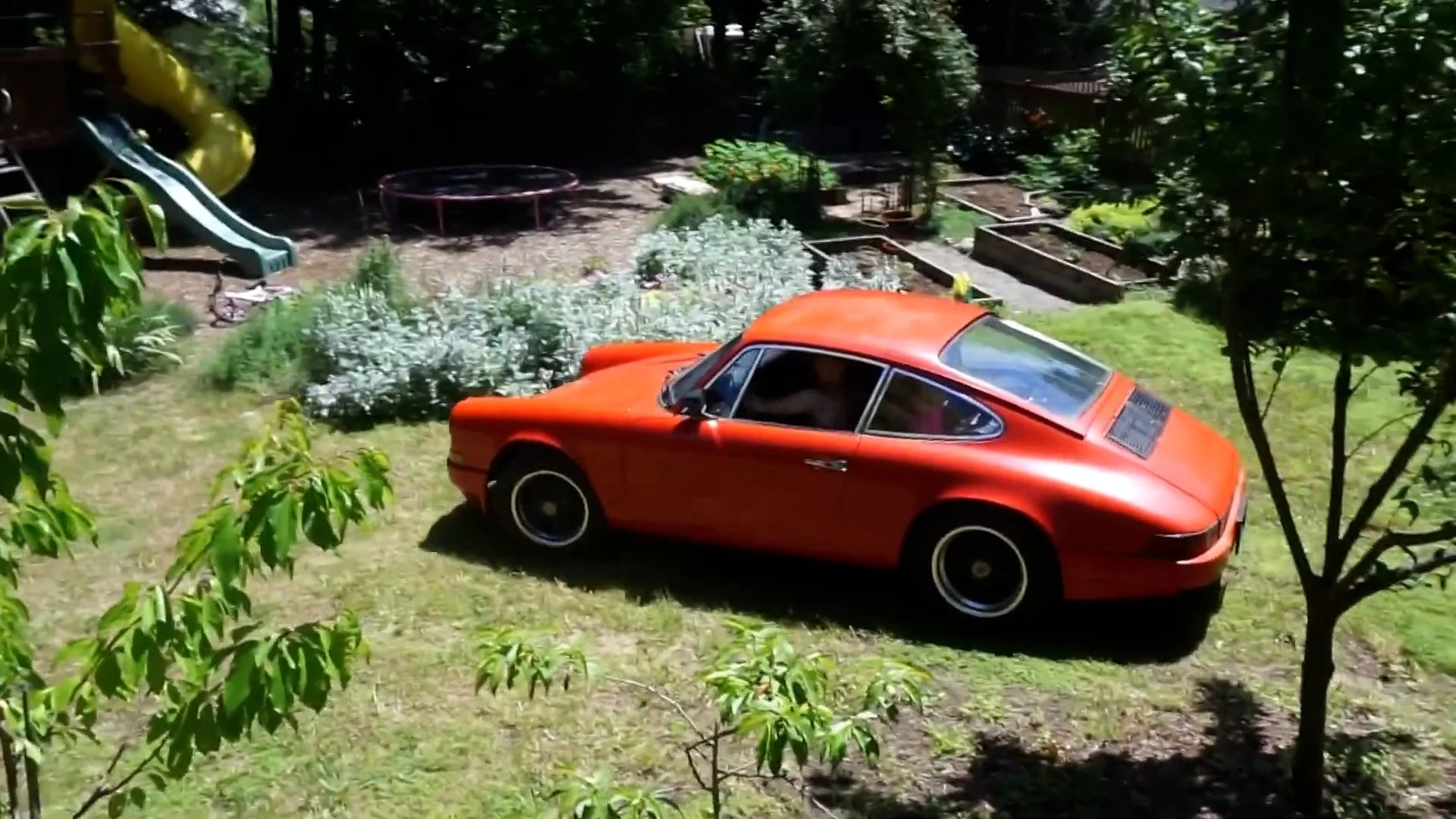
Micah’s Red 912 EV Converted and driven for the first time.
What did Chris Lennon say when a fellow Porschephile offered to electrify his Porsche?
Micah asked him one question. "Would you like to try electric?"
Chris said yes.
Then Chris came out and drove the 912 himself. "He said it needed a bit more power," Micah told me, which is a very Chris Lennon note to give. Micah's response was "challenge accepted."
To win Chris’ heart, Micah added two more motors (putting it at six motors total) and a third battery pack in the passenger footwell of his red 912, for somewhere north of 30 kilowatt hours capacity and another 50% of power.
To secure the deal with Chris, Micah called in a 'ringer' to run the red 912 at Laguna Seca in the six-motor configuration. On one particularly wild run, with the original 912 brakes - solid discs and used Spec-Miata tires - nothing exotic, the car slid around Laguna to a 1:51 elapsed time. Micah's summary of that is engineer coded and matter of fact: "It was more than that car could handle."
That was enough for Chris. And it proved the point. That 6 motor architecture went into Chris Lennon's Pikes Peak car in 2019, it ran the mountain and took third in class.
Then Micah said the line that explains the eight motors. "There's always more, right?"
What is actually inside the eight motor 911 RSR?
This is where the build stops sounding like a conversion and starts sounding like a race program.
The car now runs eight Zero Motorcycles motors through a brand new assembly that uses Gates Carbon GT2 belts to transfer power to a central shaft, feeding a Porsche 915 transaxle. Micah puts it at roughly 500 pound feet of torque and around 500 horsepower out of the batteries. His words: "So it's a pretty good mover."
The motors are Cypher II generation Zero Motorcycles' 75-7 units, which Micah pegs at about 67 horsepower each if provided a full-size Zero battery
Two independent electrical systems, four motors each
The reliability strategy is the part I did not expect. There are two completely independent electrical systems in the race car. Two batteries and four motors each. If one system faults and cannot recover, the other one keeps going.
Every piece of that is inherited. Each Zero battery is comprised of one or more cell boxes, and in an assembly has its own battery management system, contactor, fuse, and control elements. A vehicle control unit, the main bike board, decides which battery gets switched in or out based on state of charge. All of that work went into keeping motorcycle customers running on the freeway. It has now been duplicated in a race car, twice over.
To finish first, you have to finish. On this mountain that is not a cliche, it is a specification.
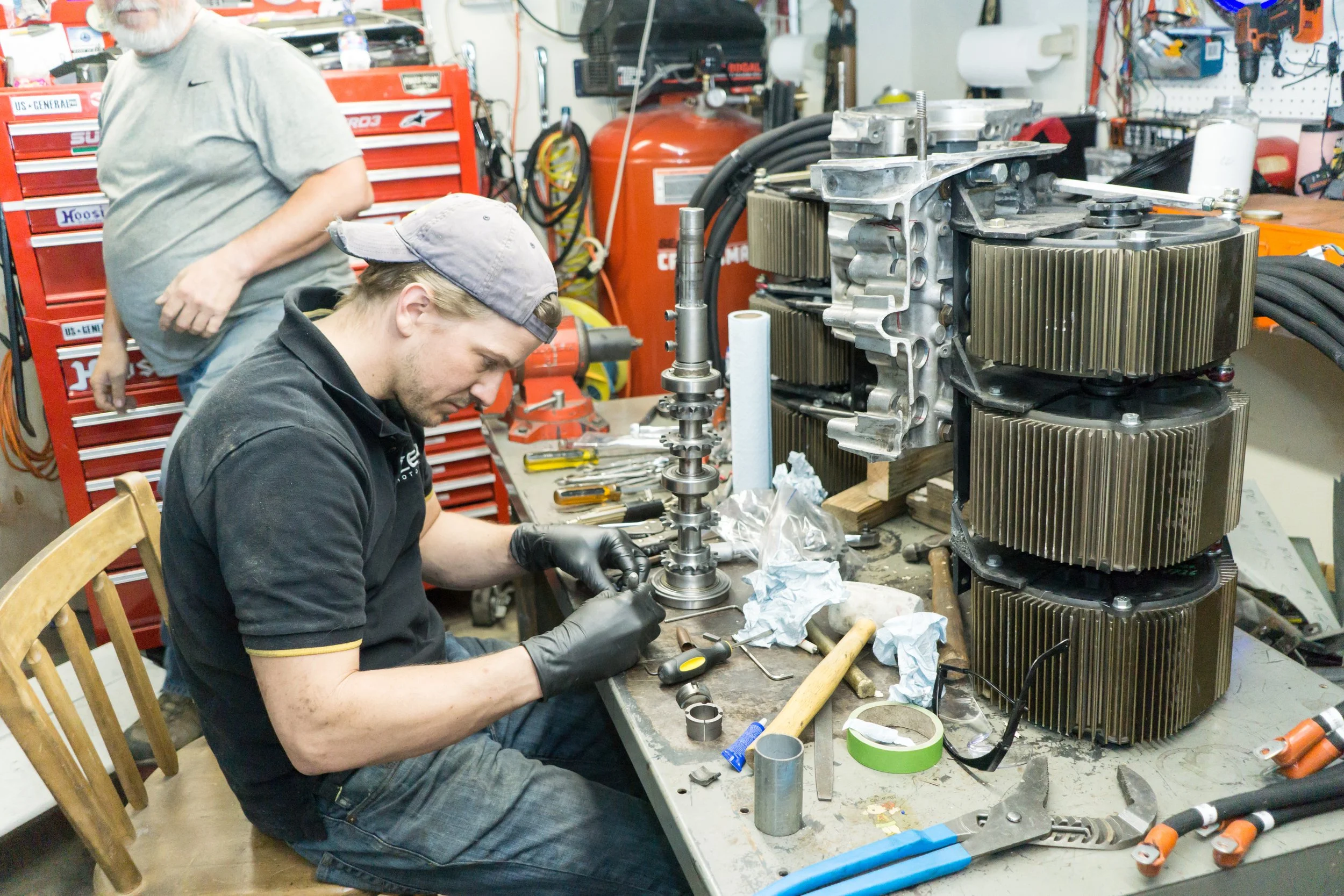
Micah working on the central shaft within the "Type IV" Porsche motor case also mounting six Zero motors
Where do the batteries live?
Two batteries sit under the hood, in the space where the fuel tank used to be. That was the elegant discovery from the original 912 build. Pull the Porsche motor, drop in the electric unit, and put batteries where the fuel went, one for one.
For a hill climb, that is not enough. The run takes roughly ten minutes at maximum power, so the car needed more capacity and more thermal mass. There is a second pair of batteries in the passenger side of the car, in the footwell and where the seat would be.
The chassis was modified up front to carry them. Micah brought in professionals to do that work, tying the mounts into the cage itself so the packs are properly secured, and the same goes for the passenger side.
Why does a 500 horsepower race car have no cooling system?
It is a completely dry car. The only fluids in it are brake fluid and transaxle fluid. Everything out of the Zero Motorcycles package is air cooled - an lovely homage to the the original air-cooled car.
Instead of pumps and loops, the car uses thermal mass to absorb the waste heat coming off batteries, motors, controllers and cables, and simply carries that heat to the top of the mountain. No leaky fittings. No pumps to find, no current draw from pumps, no switches, no integration work. Micah's version: "You just put it in, add more power, add more battery."
By the summit, everything is hot. “Uncomfortable to touch is 65-70 degrees Celsius; it's absolutely warm," he said. "But that tells you it's alive.”
The altitude is where this pays off. An internal combustion engine loses power on the way up because there is less oxygen to burn. An electric car does not care. The only way this car loses power is if a controller, a motor, or a battery hits a temperature limit. So the entire strategy is to buffer the thermal margin enough that the car reaches the summit right at the edge, and not before.
What is left of a 1973 Porsche in a car like this?
More than you would guess, and less than the badge suggests.
The car is a 911 RSR tribute. It began life as a 1967 Porsche 912, the four cylinder car that sold alongside the 911. When the 911 arrived there was an abundance of 912s, and plenty of them were turned into race cars or converted into 911s. This one was built in the early or mid-90s. Chris Lennon and his team then developed it into a Pikes Peak hill climb car.
What is still original: the floor pan, the sills, the metal framework around the doors and windows, the roof, the glass windshield, a handful of panels that mount the MacPherson struts, and a VIN plate mounted over by the bars. It is a unibody that has been reinforced with a tube frame integrated into it. The cage was added.
The suspension layout is still Porsche in its bones, but hardware is by no means stock. Brakes and suspension have been upgraded to racing spec, on the order of GT2 or GT3 Porsche components, with sway bars and coilovers. Micah was careful there in his description: brakes and dampers are competition sensitive, and a separate group inside the team manages them to the driver's requirements.
This year the focus is the chassis itself. Cleaning it up, repainting, and confirming its health before the car goes back to the mountain. The team may also wrap the car in a single color, which is partly a presentation decision and partly a sponsorship one, leaving a clean canvas for a partner who wants to put their name on this effort.
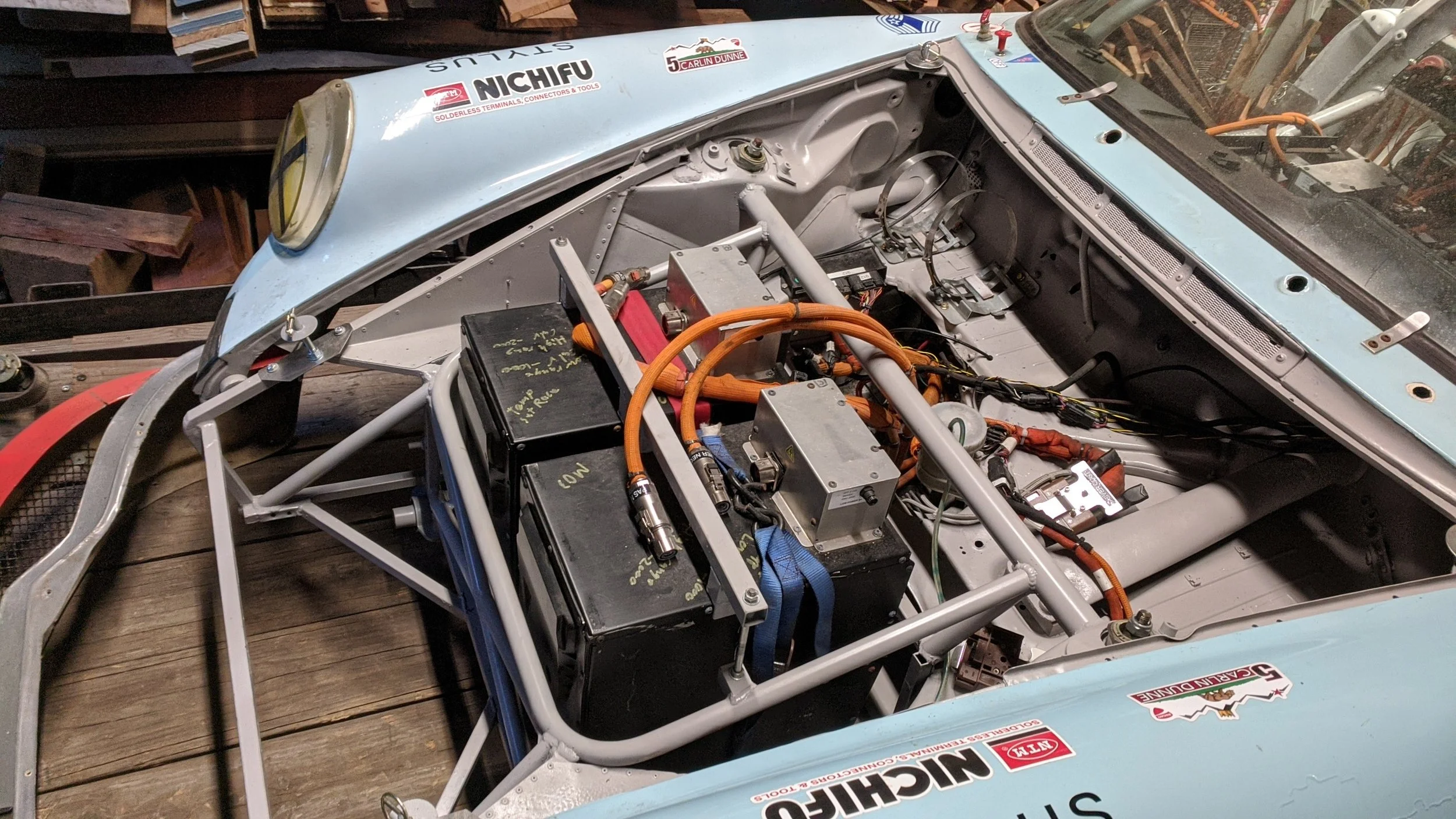
Two battery packs mounted in the front of the Porsche within the modern Tube Frame components
What will an eight motor electric Porsche actually sound like at Pikes Peak?
Pikes Peak requires electric cars to run a loud horn, something in the range of 120 decibels, so the mountain can hear them coming. Some teams have used sirens; this car has used a blaring, fire-engine-quality horn that did this job and nothing else.
That is changing. The team is bringing amplification of the motor assembly itself.
"It won't be a wave file, it won't be something artificial," Micah said. "You're going to hear the race car."
He compared it to variable intake runner length on an air cooled 911, that induction howl people chase. Inside the car with eight motors under load, he says, it screams. It is loud enough that the emotion of driving survives the conversion. You feel the torque arrive as sound when your right foot goes down.
That connects to the thing he said that stuck with me most. Without an exhaust making noise over everything, you hear the driveline, the suspension, and the tires working. "You're much closer to the machinery that drives you in this type of car."
Why 2027, and not sooner?
Because the power is already there and the control is not, yet.
Micah's reasoning is about confidence. The car has reached such a high potential in power that the team needs to prove it can rein it in, in both braking balance and suspension tuning, and that the crew has enough familiarity to command the car in any situation.
The car is going out to Colorado. Chris Lennon and the team have to work the tuning, starting with a front to rear brake ratio that suits the power, and shocks that keep the car damped through the corners of Pikes Peak, which Micah describes like hitting the berms at a track. You catch air on the wheels. The work is deliberately abusive, because the point is to find operating margin before the mountain finds it for you.
There is also 2019 to answer for. The car ran, and weather cut the event down to half the hill climb. That is the run they want back.
Look at the tires and you can see the whole problem stated in rubber. They are aggressive. There is serious power that has to go down. Some would say too much. Micah's answer to that is the cleanest description of race engineering I have heard in a while. Once you go over the limit, you have the opportunity to tune back down, to decide what is actually critical for traction, and to work on the finer details.
"We've proven feasibility, we've proven reliability," he said. "We're going to turn this into a real racer."
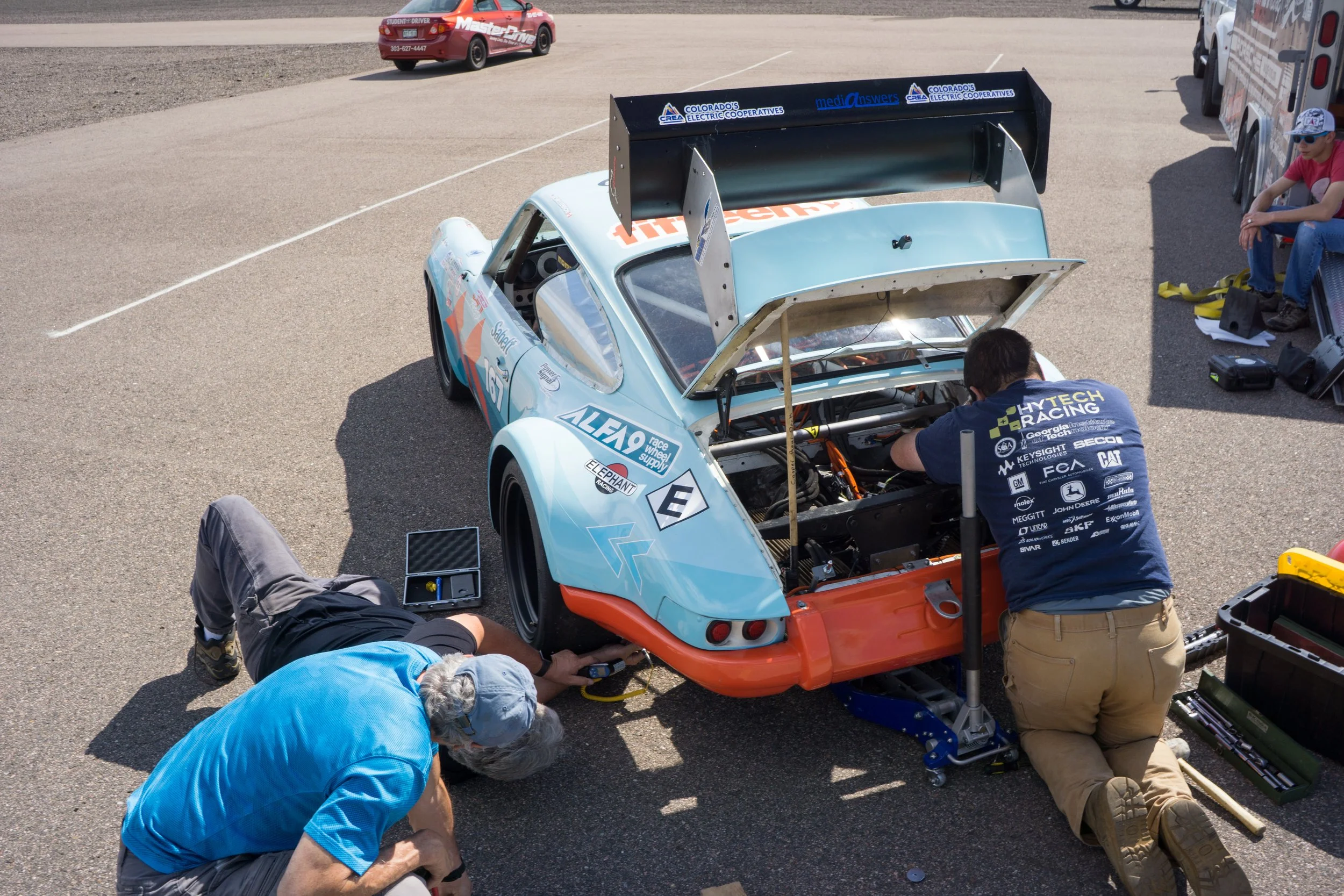
The team making adjustments to the car, still air cooled even now.
What is the actual goal on the mountain?
Two numbers.
The first is the car's own gasoline record. Chris Lennon won the vintage class in the best of several internal combustion iterations, at 10:50.
The second is ten minutes flat. Breaking ten is a major accomplishment at Pikes Peak and a barrier a lot of teams are chasing. Micah's read: "I think we can get there."
Note what is not on the list. Nobody in this project cares about 0 to 60. As Micah put it, in a hill climb, if you come to a complete stop, there is a problem. The race is won digging out of corners when the car is already carrying speed, getting to 80, 90, 100 miles an hour as fast as possible, then having command of the car through the fast lower sections. This car delivers substantial torque from very low rpm all the way through the band, without the peaks and drop offs other cars fight. That predictability is what gives the driver confidence.
What has to happen before race day?
Race week is the smallest part of the job.
Roughly two months out, people start cycling in and out and the list turns logistical. Brake sets and wheel sets assembled. Enough equipment on the trailer. A tow vehicle procured if the current one will not do. Food and clothing for the crew. Sponsors briefed and included, because the team wants partners inside the effort rather than watching it.
About a month before the hill climb, PPIHC runs full test days, tire test days on the mountain, and the team intends to be there. Then race week itself is practice and qualifying, with practice starting at sunup and the course handed back to the public afterward so ordinary drivers can go up the mountain.
Micah's summary of all of it: the win is in the preparation, the win is not in the day.
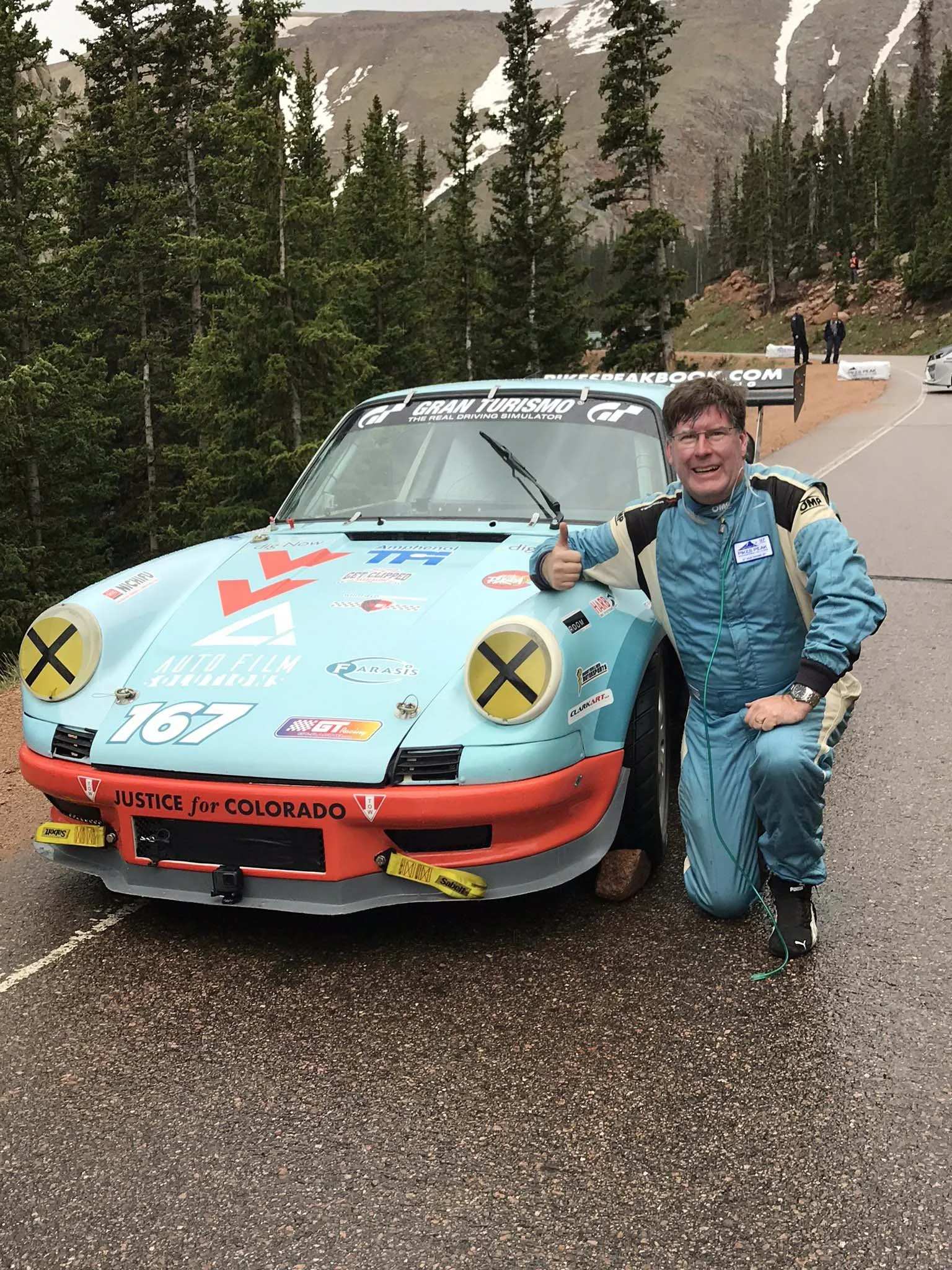
Chris after a run with the EV converted 911 Porsche RSR.
Why this car, when you could pick any car?
I asked that last, and it was the only question that slowed him down.
New cars are extraordinary. Safe, fast, technically brilliant, genuinely enjoyable. That is not what this is. This one, he said, tugs at heartstrings.
For some people it is the 911 shape, a silhouette still in production more than sixty years on. For Micah it is being an eight year old boy, then a ten year old boy, with his foot braced on the roll cage of his father's autocross car, sitting up in the seat to see over the dashboard while they negotiated cones in the late 90s.
"That's what I want. That's what I love."
That is the part a spec sheet cannot carry. A man's family Porsche broke, he refused to let it die, and the fix escalated until it became a race car with eight motors, two independent electrical systems, and a class win in its history that it is now trying to beat.
Ten minutes on Pikes Peak is a hard number. This car is going to make an unbelievable noise trying to get there. We are going to be filming all of it.
The eight motor Pikes Peak Porsche at a glance
- Car
- 1973 Porsche 911 RSR tribute, built from a 1967 Porsche 912
- Owner and driver
- Chris Lennon
- EV conversion lead
- Micah Bayless
- Motors
- Eight Zero Motorcycles Cypher II generation motors, about 67 horsepower each
- Output
- Approximately 500 horsepower and 500 pound feet of torque at the battery
- Drivetrain
- Gates Carbon GT2 belts to a central shaft, into a Porsche 915 transaxle
- Electrical architecture
- Zero Motorcycles Cypher II-based fully independent systems, two batteries and four motors each
- Battery locations
- Two under the front hood in the old fuel tank space, two in the passenger footwell and seat area
- Cooling
- None. Air cooled throughout, thermal mass absorbs waste heat
- Summit temperatures
- Near the limits - Competition Sensitive!
- Original chassis
- Floor pan, sills, door and window framework, roof, glass windshield, MacPherson strut mounting panels, VIN plate
- Chassis construction
- Unibody reinforced with an integrated tube frame and added cage
- Suspension
- Full coilovers, and sway bars
- Prior results
- Pikes Peak Vintage class win on gasoline, third in the Exhibition class in 2019 as an EV
- 2019 outcome
- Weather cut the event to half the hill climb
- Targets for 2027
- Beat the car's own gasoline time of 10:50 and break the ten minute barrier
- Course
- 156 turns, finishing at 14,115 feet
Frequently asked questions about the eight motor electric 911 RSR
How much power does the eight motor Porsche 911 RSR make?
Roughly 500 horsepower and about 500 pound feet of torque out of the batteries, produced by eight Zero Motorcycles motors driving a central shaft through Gates Carbon GT2 belts and a Porsche 915 transaxle.
Why does an electric car have an advantage at Pikes Peak?
Because it does not lose power to altitude. An internal combustion engine loses output near the summit because there is less oxygen to burn. This car only loses power if a controller, motor, or battery reaches a temperature limit, which is exactly what the thermal mass strategy is designed to prevent.
Is the eight motor 911 RSR water cooled?
No. It is a completely dry car apart from brake fluid and transaxle fluid. Every component from the Zero Motorcycles package is air cooled - a fun homage to the air-cooled engines of the past. The build uses thermal mass to absorb waste heat over the run.
Is the 1973 Porsche 911 RSR a real RSR?
It is a tribute. The car began as a 1967 Porsche 912 and was converted in the early to mid-90s, then developed by Chris Lennon and his team into a Pikes Peak hill climb car. The floor pan, sills, roof, window and door framework, glass windshield, and strut mounting panels are original, reinforced with an integrated tube frame.
What time does the team need to run in 2027?
Two targets. Beating the car's own gasoline class winning time of 10:50, and breaking ten minutes, which is a benchmark accomplishment at the Pikes Peak International Hill Climb.